

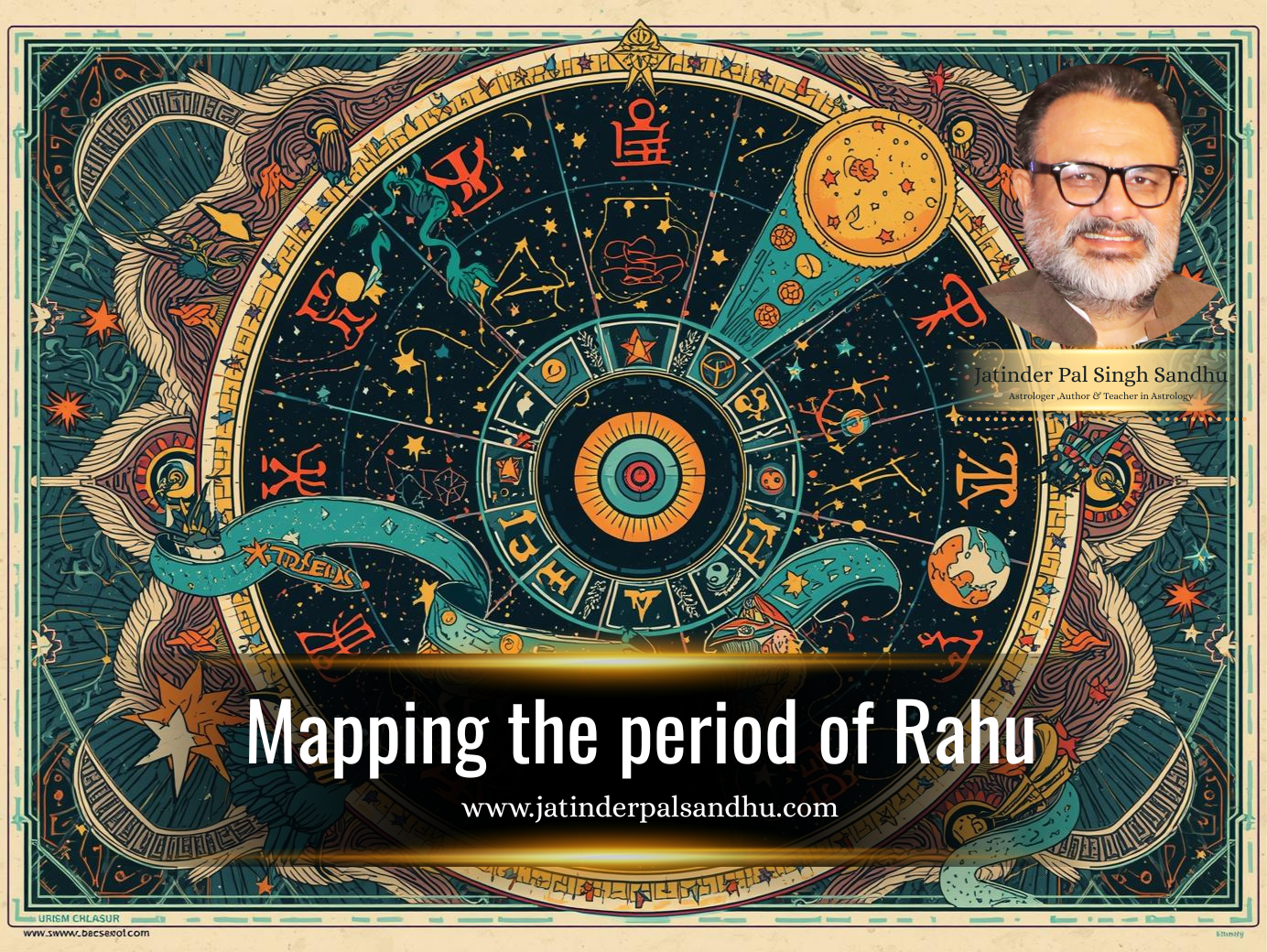
Mapping the period of Rahu is never easy in classical astrology. –Unlike other grahas, Rahu does not act independently in a straightforward manner. Its results are layered, borrowed, modified, amplified, and sometimes distorted through several factors operating simultaneously.
A proper understanding of Rahu Mahadasha requires studying the following carefully: The sign Rahu occupies, the house Rahu occupies, The lord of the sign (dispositor), Planets conjunct Rahu, Planets aspecting Rahu, Strength and dignity of associated planets, Antar-dasha lord relationships, The condition of the dispositor from Rahu itself.
A common mistake is judging Rahu only by house placement.
For example: Rahu in Sagittarius may behave very differently depending upon Jupiter’s condition.
If Jupiter is exalted, strong, well-placed, and connected to benefics, Rahu often gains direction, purpose, expansion, learning, and institutional support.
But if Jupiter is weak, afflicted, debilitated, combust, or placed unfavorably from Rahu, the same Rahu can produce confusion, instability, false optimism, ideological conflicts, or misdirected expansion.
This is because Rahu largely channels itself through its dispositor.
Another important point: The dispositor should preferably be favorably placed from Rahu itself.
For instance: In kendras or trikonas from Rahu → generally supportive. In 6th → struggle-oriented but can give growth through conflict- In 8th or 12th from Rahu → instability, hidden issues, psychological pressure, losses, detachment, or sudden reversals may increase.
The dignity of the dispositor also matters: Exalted dispositor strengthens Rahu’s capacity. Debilitated dispositor weakens guidance and coherence. Own sign or mooltrikona gives stability. Affliction modifies the entire Rahu period
Further complexity comes from Antar-dashas.
Each Antar-dasha lord colors Rahu differently depending on: Friendship or enmity with Rahu. Functional benefic or malefic nature. Placement from Lagna. Placement from Rahu. Association with Rahu or its dispositor, Strength in divisional charts
Thus Rahu–Jupiter, Rahu–Saturn, Rahu–Venus, or Rahu–Mars can feel like completely different Mahadashas within the same Rahu period.
In many charts, people say: “My Rahu Mahadasha is not behaving as expected.”
The reason is simple: Rahu itself is rarely the entire story.
Rahu acts like a magnifier and amplifier of the karmic network connected to it. To judge Rahu correctly, one must judge the ecosystem around Rahu — not Rahu alone.
A proper assessment of Rahu Mahadasha requires careful study of:
- The sign Rahu occupies
- The house Rahu occupies
- The sign lord (dispositor)
- Planets conjunct Rahu (primary influence)
- Planets strongly associated with Rahu
- Aspects or influences on Rahu (secondary modifiers)
- Strength and dignity of connected planets
- Antar-dasha lord relationships
- The condition and placement of the dispositor from Rahu itself
Further complexity comes through Antar-dashas. Each Antar-dasha lord reshapes Rahu differently depending on:
- Relationship with Rahu
- Functional benefic or malefic nature
- Placement from Lagna
- Placement from Rahu
- Association with Rahu or its dispositor
- Strength in divisional charts
Thus, Rahu–Jupiter, Rahu–Saturn, Rahu–Venus, or Rahu–Mars can feel like entirely different Mahadashas within the same Rahu period.
This is why many people feel their Rahu Mahadasha is “not behaving as expected.” Rahu itself is rarely the whole story. Rahu acts more like a magnifier of the karmic ecosystem surrounding it.
To judge Rahu properly, one must study:
- Placement
- Association and conjunction (most important)
- Dispositor strength and condition
- Secondary influences and aspects
- Antar-dasha modifications
Rahu does not merely give its own results — it amplifies the network it is connected to.
About the Author