
For both Aquarius and Scorpio Lagnas, Jupiter owns the 2nd house, a principal Maraka sthāna. This ownership inevitably imparts a maraka quality to Jupiter, regardless of its natural benefic nature. Although Jupiter continues to signify wisdom, dharma, children, wealth, and grace through its natural significations, its functional role for these two ascendants is blemished by 2nd-house lordship.
This has an important consequence. The foremost natural benefic, which ordinarily protects and nourishes the horoscope, loses some of its ability to function as an unqualified benefic. For Scorpio Lagna, Jupiter also owns the 5th house, making it a powerful functional benefic, yet its ownership of the 2nd prevents it from being entirely free of maraka influence. For Aquarius Lagna, Jupiter owns the 2nd and 11th houses, rendering it predominantly a functional malefic with pronounced maraka tendencies.
The remaining natural benefics also suffer functional limitations. For Scorpio Lagna, Venus owns the 7th and 12th houses, becoming both a maraka and the lord of expenditure. Mercury owns the 8th and 11th houses, thereby acquiring significant functional maleficence. Thus, none of the natural benefics remains entirely free from blemish.
For Aquarius Lagna, Venus is undoubtedly the Yogakāraka by virtue of owning the 4th and 9th houses. However, Mercury owns the 5th and 8th houses, and the ownership of the 8th introduces an inherent flaw. Jupiter, as lord of the 2nd and 11th houses, is already functionally malefic. Consequently, even here the number of unqualified benefic influences is limited.
Another noteworthy feature is the disposition of the Lagna lords themselves. For Aquarius Lagna, Saturn, the ascendant lord, simultaneously owns the 12th house. Thus, the very planet responsible for vitality, health, and self-identity also carries the agenda of loss, expenditure, isolation, and liberation. Although Saturn remains the Lagna lord and retains its primary responsibility to protect the native, the simultaneous ownership of the 12th introduces an inherent duality into its functioning.
For Scorpio Lagna, Mars owns both the 1st and the 6th houses, with its Mūlatrikona sign, Aries, falling in the 6th house. Mars is also the natural significator (kāraka) of the 6th house, representing disease, injuries, conflicts, infections, surgery, and the body’s defensive mechanisms. Consequently, if Mars is weak, afflicted, or heavily influenced by malefic planets, the native’s vitality, resistance to disease, and immunity may be significantly compromised. The Lagna lord thus becomes deeply intertwined with sixth-house matters.
An interesting parallel emerges between these two ascendants. Saturn, the Lagna lord of Aquarius, is the natural significator of the 6th, 8th, and 12th houses—the three principal Duṣṭhānas. Mars, the Lagna lord of Scorpio, owns the 6th through its Mūlatrikona sign while simultaneously being the natural significator of the 6th house. Thus, in both ascendants, the very planet governing the self is closely connected with difficult houses either through ownership or natural significations. This creates an inherent vulnerability, particularly when the Lagna lord is afflicted.
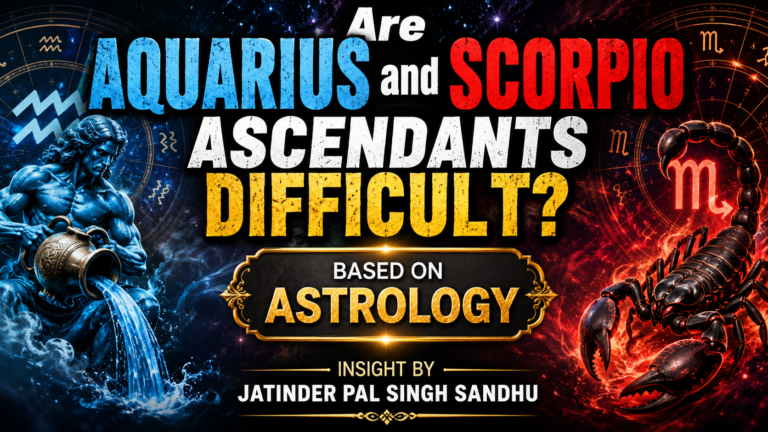
These factors may collectively explain why many classical astrologers regarded Scorpio and Aquarius as comparatively challenging ascendants. The issue extends beyond their Lagna lords being natural malefics. The principal natural benefic, Jupiter, is functionally blemished by maraka ownership; the remaining benefics are also functionally compromised; and the Lagna lords themselves possess intrinsic associations with the difficult houses. The cumulative effect is a relative reduction in the horoscope’s natural protective influences, making these ascendants more sensitive to planetary afflictions than many others.
These are, however, broad functional principles rather than rigid rules. A strong Lagna, a powerful and unafflicted Lagna lord, benefic aspects, auspicious yogas, and favourable daśās can substantially mitigate these inherent challenges and enable the native to achieve exceptional success and longevity.
This formulation also highlights an important conceptual point: Scorpio and Aquarius are “structurally stressed” ascendants. The challenge does not arise from any single factor, but from the cumulative overlap of maraka ownership, duṣṭhāna ownership, natural kārakatva, and the relative weakening of benefic functional support. This cumulative approach is more convincing than relying on any one rule in isolation.
About the Author