
Ekāntik Graha — Condensed Definition and Judgement
Definition
An Ekantik Graha is a planet that occupies a rasi or bhava alone, without conjunction of another graha in that same place.
Its results, therefore, tend to manifest in a more direct, concentrated, and unblended form.
However, solitary occupation does not mean complete independence. Such a planet is still modified by:
- graha drsti / rasi dṛṣṭi
- dispositor / rasi lord
- Parivartana and other sambandhas
- combustion, avasthā, bala, varga strength
- Rahu–Ketu axis and wider karmic context
So the correct definition is:
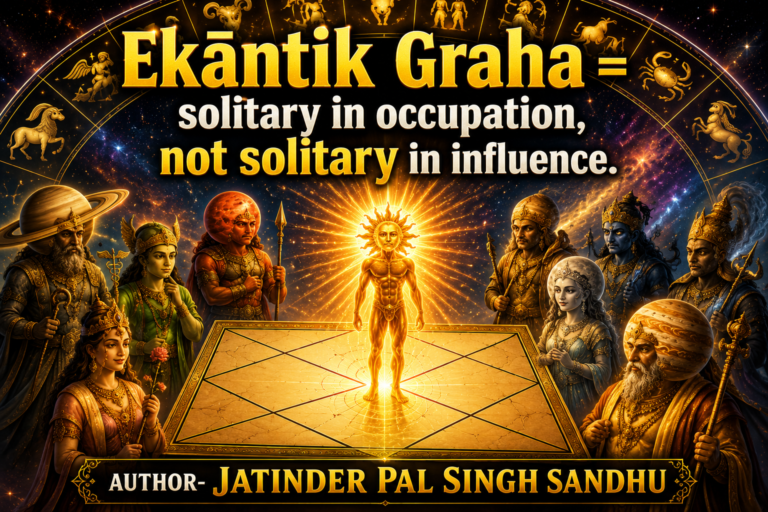
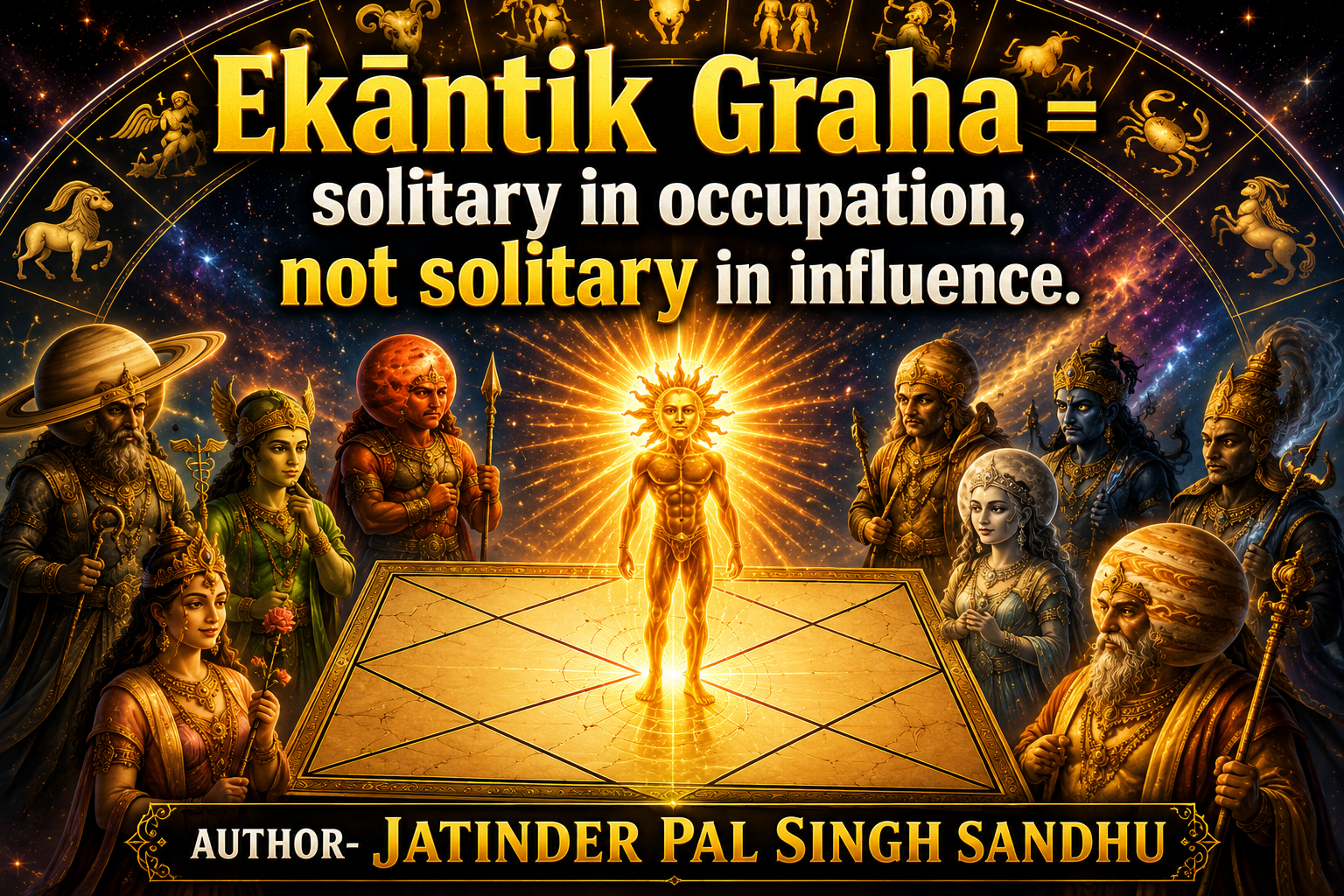
Ekantik Graha = solitary in occupation, not solitary in influence.
Main Principle
Solitude by itself is neither a strength nor a weakness.
It simply means the planet acts less blended with another graha, so its own nature becomes more visible.
- If the graha is strong, dignified, well-supported → solitude may preserve clarity and purity of expression.
- If the graha is weak, afflicted, or ill-placed → solitude may expose its defect more starkly.
Thus, solitude should be read as unmixed expression, not automatically as power.
When Solitude Helps
A solitary graha may express well when:
- in own sign, exaltation, mulatrikoṇa, or friendly sign
- supported by digbala, vargottama, śadbala
- receiving benefic aspect
- , having a strong dispositor
- owning and occupying favourable houses
In such cases, the graha’s agenda operates more cleanly because no co-tenant disturbs it.
When Solitude Hurts
Solitude becomes difficult when the planet is:
- debilitated, combust, defeated, or weak
- placed in a difficult house without support
- under harsh malefic influence
- dependent on a weak or afflicted dispositor
Then the planet may simply suffer alone, expressing its weakness more nakedly.
Solitary Benefic vs Solitary Malefic
1. Solitary Benefic
A solitary Jupiter, Venus, strong Mercury, or waxing Moon may show:
- clearer wisdom, refinement, sensitivity, intelligence
- cleaner delivery of house results
- less corruption from malefic conjunction
- greater purity in the occupied house
But if weak, even a benefic may become ineffective rather than protective.
2. Solitary Malefic
A solitary Saturn, Mars, Sun (contextually), Rahu, or Ketu may show:
- concentrated austerity, force, ambition, pressure, severance, detachment
- stronger impact on the occupied house
- harsher expression if unaided by benefics
Examples:
- Saturn → discipline, delay, endurance, reserve
- Mars → courage, impatience, conflict, force
- Rāhu → obsession, irregularity, hunger, ambition
- Ketu → severance, detachment, internalisation, drying of house significations
A solitary malefic is not always bad; if strong, it may give stamina, courage, resilience, or renunciation.
Effect of House Placement
Kendras (1, 4, 7, 10)
A solitary graha becomes highly visible and structurally important.
- benefic → strongly shapes life direction, home, marriage, career
- malefic → strongly colours the house with pressure, duty, conflict, detachment, ambition
Example:
- Jupiter alone in 1st → self-directed wisdom
- Saturn alone in 10th → heavy career duty, perseverance
- Mars alone in 7th → assertive or conflict-prone relationships
Trikoṇas (1, 5, 9)
A solitary graha expresses itself through dharma, intelligence, merit, belief, and inner orientation.
- benefic → clear ethical, devotional, intellectual expression
- malefic → may harden, delay, or redirect trinal significations
Examples:
- Jupiter alone in 9th → independent philosophy, faith, guidance
- Saturn alone in the 5th → seriousness in study, delayed children, emotional reserve
- Ketu alone in 9th → inward or unconventional spirituality
Duṣṭhānas (6, 8, 12)
Here, solitude often becomes karmically concentrated, inward, and stark.
6th
Self-contained struggle with enemies, debts, service, disease, and labour.
8th
Concentrated themes of vulnerability, secrecy, sudden breaks, chronic strain, and transformation.
But the nature of the graha matters:
- Saturn → endurance amid prolonged difficulty
- Jupiter → some protection or wisdom in crisis
- Ketu → may sever 8th-house significations rather than deepen them
12th
Withdrawal, loss, expenditure, isolation, foreign residence, sleep, spiritual retreat.
- benefic → may spiritualise
- malefic → may intensify alienation, loss, renunciatory pressure
Rāhu–Ketu and Solitary Status
If Rāhu or Ketu are in the same sign/house
Then the planet is not Ekāntik, because a conjunction exists.
- Mars + Ketu → Mars not solitary
- Moon + Rāhu → Moon not solitary
If the nodes are elsewhere on the axis
The planet remains Ekantik by occupation, but its results are still strongly modified by the nodal axis.
Example:
- Ketu alone in 8th / Rahu in 2nd → Ketu is solitary, but the 2–8 axis must be judged as one karmic field
- Rāhu alone in 10th / Ketu in 4th → solitary by conjunction, but 4–10 axis is deeply coloured by nodal polarity
So the rule is:
Rāhu–Ketu cancel Ekantik status only by conjunction, not merely by being on the opposite axis.
How to Judge an Ekantik Graha
Always examine:
- Natural and functional nature
Is the graha benefic or malefic for that lagna? - Strength and dignity
Sign, bala, varga, avasthā, combustion, etc. - Condition of the dispositor
A solitary planet under a damaged dispositor may not act freely at all. - Aspects received
Benefic support vs malefic pressure changes everything. - House occupied and houses owned
Solitary lordship in a good house differs from a solitary functional malefic in a duṣṭhāna. - Purity vs exposed defect
This is the core question:- Is solitude preserving the graha’s clarity?
- Or simply exposing its weakness?
Final Conclusion
Ekāntik Graha is not a yoga in itself.
It is a condition of planetary expression: a planet standing alone in a house/sign tends to act in a more direct, concentrated, and less blended way because no co-tenant shares its field.
But it is never judged by solitude alone. Its actual results depend on:
- strength or weakness of the graha
- dignity and bala
- dispositor
- aspects
- house ownership and placement
- nodal / karmic context
So the practical rule is: If the solitary graha is strong and well-supported, solitude preserves clarity.
If it is weak, afflicted, or badly placed, solitude makes its defect more pronounced.
About the Author